Power Macintosh G3 (Blue & White)
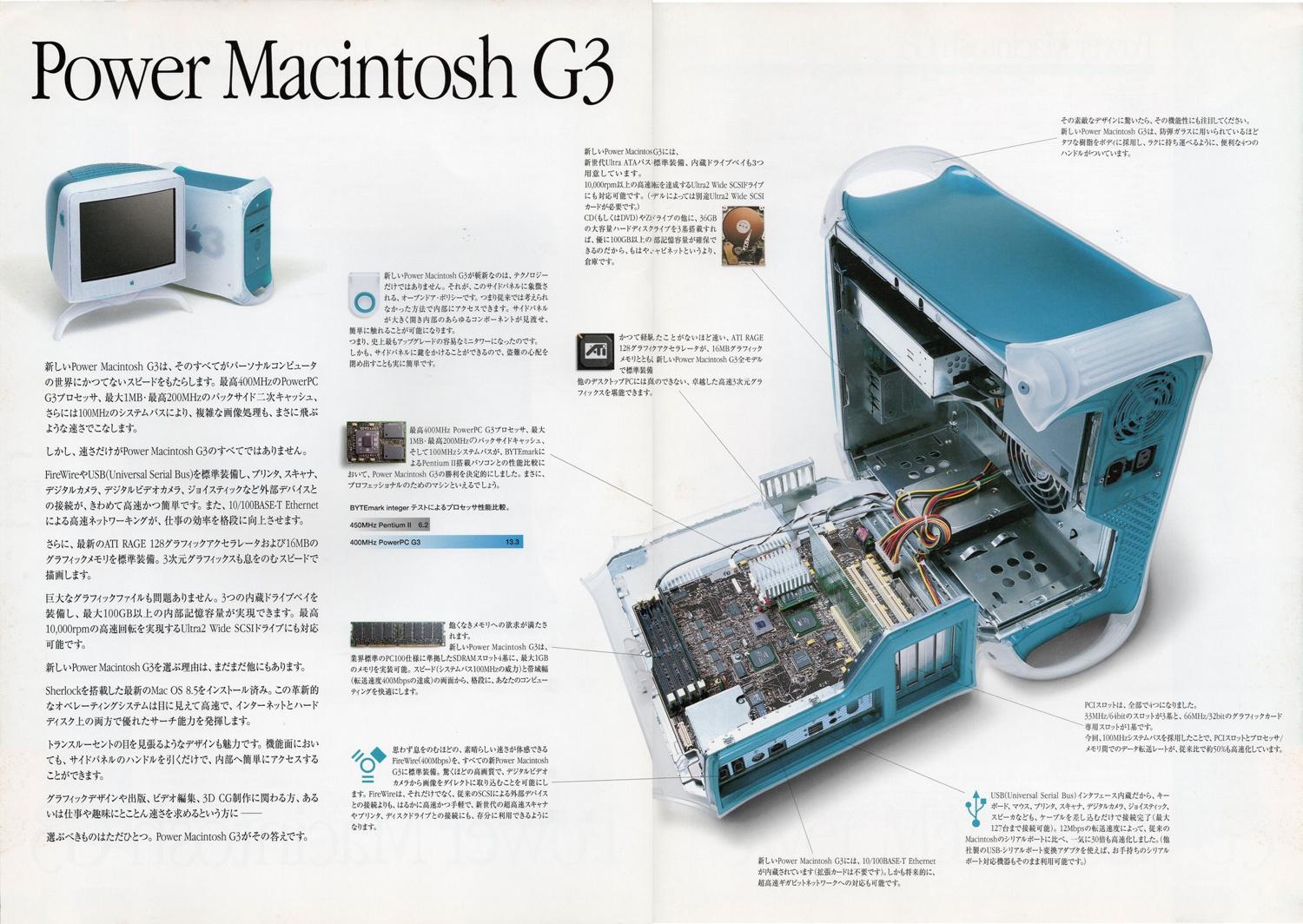
The Blue & White Power Macintosh G3 redesigned Apple’s professional tower around a translucent enclosure and a side door carrying the logic board. USB and FireWire joined built-in Fast Ethernet, while ADB remained for existing input devices.
- First available
- January 5, 1999
- Discontinued
- October 13, 1999
Image: Apple, Inc. — via apple-history.com · Rights reserved; no open reuse license stated by the collection ↗
History
This initial inventory revision follows the original developer note’s 300, 350 and 400 MHz processor roster. It introduced the 100 MHz system bus and New World ROM-in-RAM architecture to the professional G3 tower; the later 350/400/450 MHz roster belongs to a subsequent configuration update.
Four SDRAM DIMM sockets and three general-purpose PCI slots provided expansion, with a separate faster PCI slot for the ATI RAGE 128 graphics card. The original note’s ADB-current figure was later corrected by Apple to 500 mA across connected ADB devices.
Media 3
View all ↗
3 of 3 records
Details
Specifications
22 fields
- Processor
- PowerPC G3, 300/350/400 MHz
- System bus
- 100 MHz
- Memory
- PC100 SDRAM; four DIMM slots; up to 1 GB
- Graphics
- ATI RAGE 128 graphics card; 16 MB SDRAM
- PCI
- Three 64-bit 33 MHz expansion slots; one 32-bit 66 MHz graphics slot
- Storage interface
- Ultra ATA/33; optional Ultra2 LVD SCSI card/drive
- Optical drive
- ATAPI CD-ROM; optional DVD-ROM configuration
- USB
- Two USB ports
- FireWire
- Two 400 Mbit/s FireWire ports
- Networking
- Built-in 10/100BASE-T Ethernet
- Legacy input
- ADB port retained; no built-in legacy serial or SCSI ports
- Original USB connector and data rates
- USB Type A connectors; low-speed 1.5 Mbit/s and 12 Mbit/s transfers ↗
- Original USB controller standard
- Open Host Controller Interface (OHCI); early devices unable to interoperate with OHCI are unsupported by the documented Macintosh USB software ↗
- Original bundled USB software
- Macintosh USB system software 1.1 provides control, bulk, interrupt and isochronous transfer functions ↗
- Original USB storage startup limitation
- The Macintosh USB software described by the original developer note does not support booting from external USB storage; no assertion about later software or firmware ↗
- Original FireWire power budget
- Up to 15 W total on both connectors; not 15 W on each connector ↗
- Original FireWire off-state bus power
- When the computer is off, the power pin accepts external bus power from 8 to 33 V as described against the P1394a draft ↗
- Original FireWire transfer modes
- Hardware and software support the asynchronous and isochronous transfers defined by IEEE 1394-1995; peripheral drivers are required ↗
- Original simultaneous audio input/output
- 44.1 kHz, 16-bit stereo sound input and output can operate simultaneously ↗
- Original sound-output connection
- Rear 3.5 mm output for headphones or amplified speakers; inserting a plug disconnects the built-in speaker ↗
- Original sound-input electrical scope
- Stereo 3.5 mm input accepts line-level source or PlainTalk microphone; input impedance 20 kΩ and maximum undistorted level 2.5 V peak-to-peak ↗
- Original Ethernet link sensing
- Built-in RJ-45 port automatically senses 10BASE-T or 100BASE-TX connection ↗
Models
1 record
- Model numbers
- M5183
- Identifiers
- PowerMac1,1
| Model | Model number | Identifier |
|---|---|---|
| Power Macintosh G3 (Blue & White) ↗ | M5183 | PowerMac1,1 |
Sources
4 sources
- AppleDB — Power Macintosh G3 (Blue & White)Reference
- Wikipedia contributors — List of Mac modelsReference
- Apple Developer Note — Power Macintosh G3 (Blue & White), 1998Original source
- Apple — Blue & White G3 later technical specificationsOriginal source
Checked against preserved original Apple documentation. Configuration and software-version distinctions are retained rather than inferred from a shared enclosure.
Catalog data: MIT (AppleDB); CC BY-SA 4.0 (Wikipedia contributors)