Apple SOS
SOS, pronounced “sauce,” gave the Apple III a file and device system designed around named devices, hierarchical directories and configurable drivers.
- First available
- 1980
Public release date from the cited version history, retaining its stated precision. Announcement and beta availability are not substituted for the public release. The preserved primary documentation establishes the described platform and features; an exact announcement date is not inferred.
History
Apple’s two-volume reference separates how the system works from its system calls. Its driver model and pathnames were a different environment from Apple II DOS, and influenced the later ProDOS design.
Media 8
View all ↗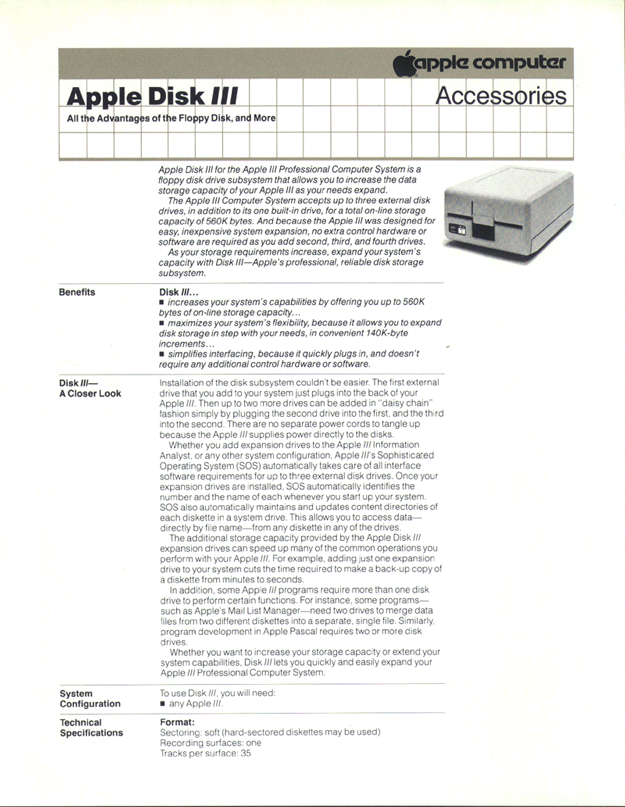
1981 Apple Disk III Dealer Spec Sheet · Front
1981Brochure
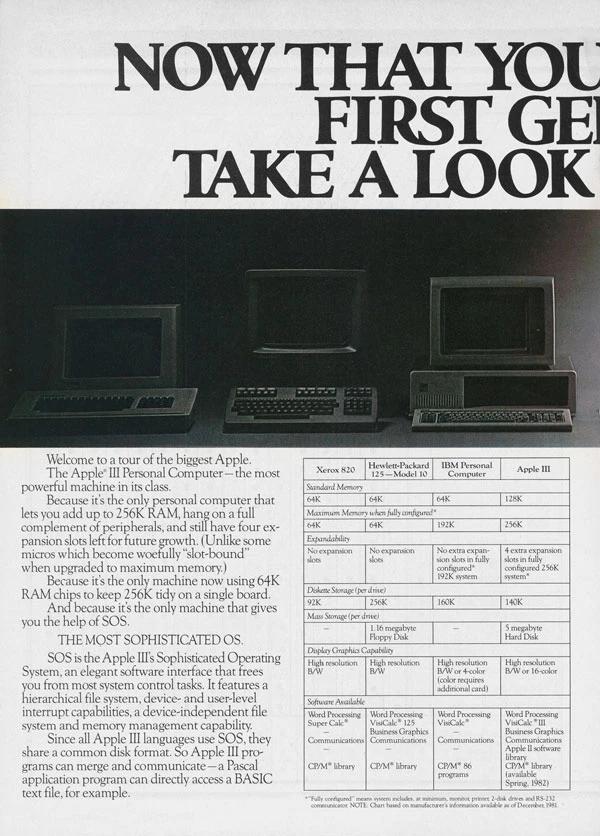
Apple III "Third Generation" Ad · Page 1
UndatedPrint ad
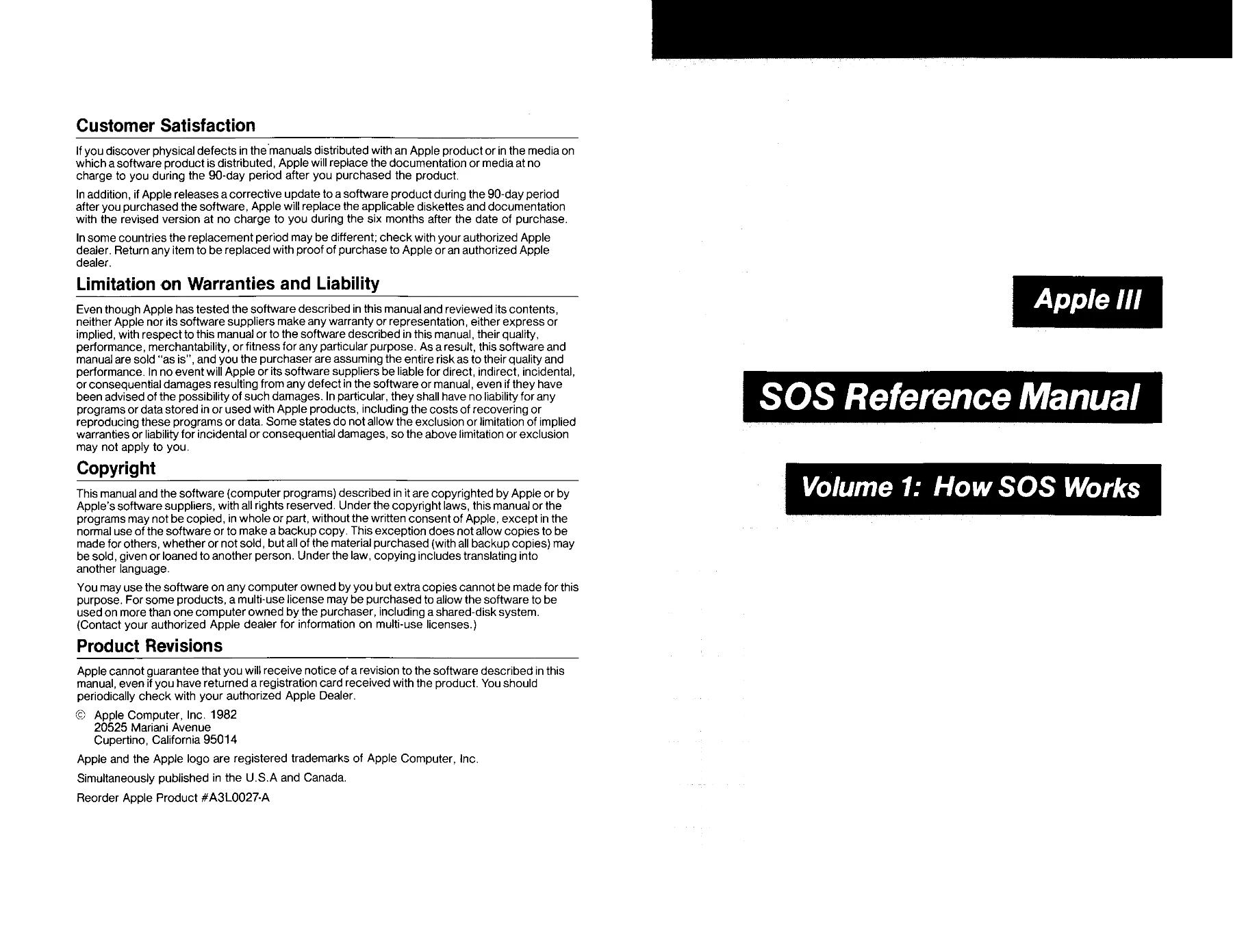
Apple III SOS Reference Manual — Volumes 1 and 2
UndatedManual
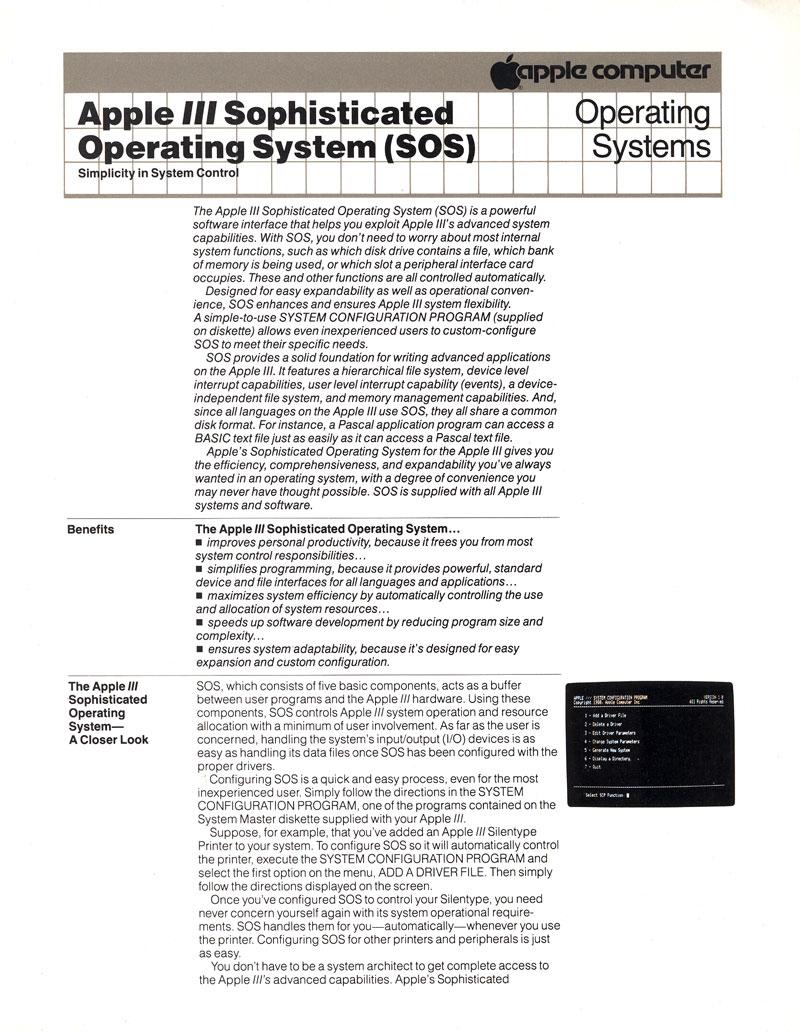
1981 Apple III SOS Dealer Spec Sheet · Page 1
1981Brochure
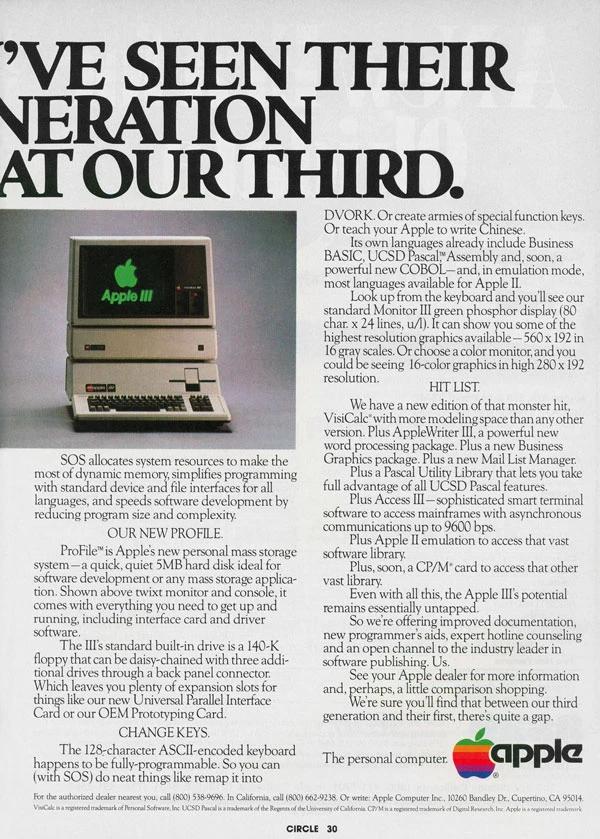
Apple III "Third Generation" Ad · Page 2
UndatedPrint ad
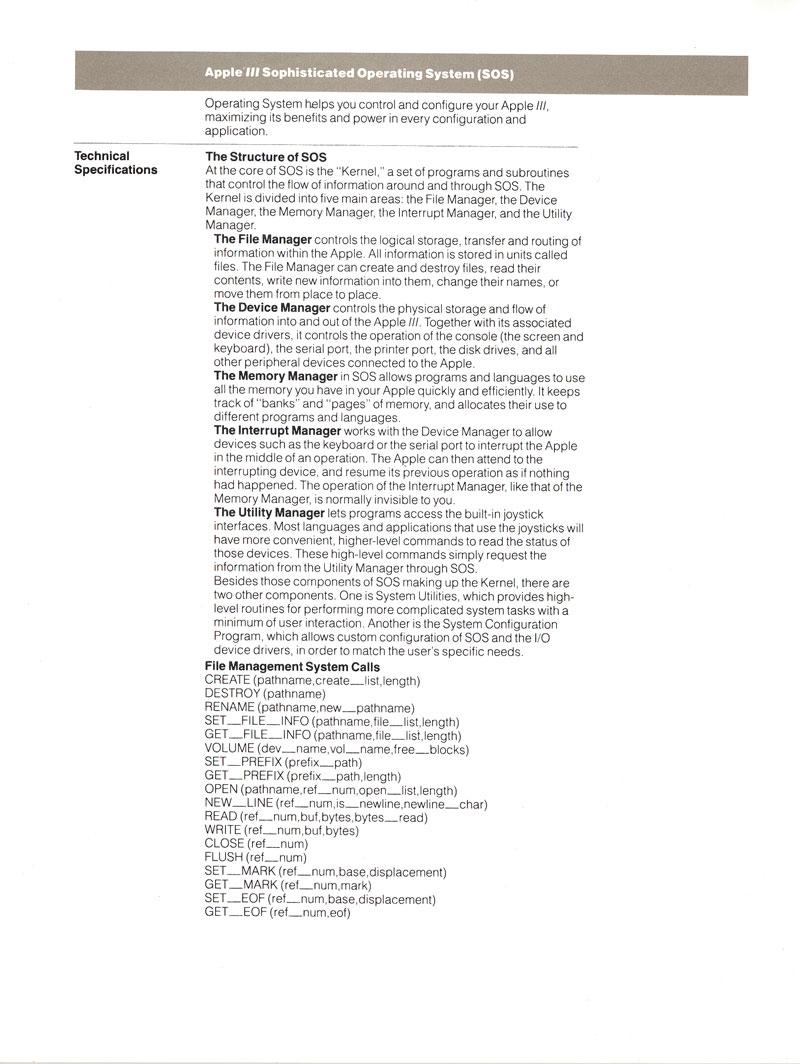
1981 Apple III SOS Dealer Spec Sheet · Page 2
1981Brochure
6 of 8 records
Details
Specifications
18 fields
- Software type
- Operating system
- Version
- SOS
- Platform / requirements
- Apple III; 6502 processor; SOS-compatible device drivers
- Key changes
- Sophisticated Operating System; hierarchical directories; device-independent I/O; relocatable drivers
- Volume 1 manual: interpreter model
- One 6502 assembly-language interpreter is loaded at boot and is required for operation; the manual names Business BASIC, Pascal and Apple Writer III as examples ↗Documented in the retained Volume 1 manual. No SOS release version or original introduction date is inferred from the 1982 copyright.
- Volume 1 manual: boot files
- SOS is resident and is loaded from the boot disk’s SOS.KERNEL and SOS.DRIVER files ↗Documented in the retained Volume 1 manual. No SOS release version or original introduction date is inferred from the 1982 copyright.
- Volume 1 manual: built-in disk driver
- The Disk III driver is part of SOS.KERNEL; the user cannot remove or change it except to specify the number of drives ↗Documented in the retained Volume 1 manual. No SOS release version or original introduction date is inferred from the 1982 copyright.
- Volume 1 manual: driver configuration
- Use the System Configuration Program option on the Utilities disk to add, change or remove drivers in SOS.DRIVER ↗Documented in the retained Volume 1 manual. No SOS release version or original introduction date is inferred from the 1982 copyright.
- Volume 1 manual: call families
- Four call groups cover file, device, utility and memory management ↗Documented in the retained Volume 1 manual. No SOS release version or original introduction date is inferred from the 1982 copyright.
- Volume 1 manual: BRK interface
- The 6502 BRK instruction invokes software-emulated four-byte SOS operations ↗Documented in the retained Volume 1 manual. No SOS release version or original introduction date is inferred from the 1982 copyright.
- Volume 1 manual: memory capacity
- The architecture and SOS describe access to 512K bytes through enhanced addressing; a footnote limits the then-current hardware to 256K bytes ↗The architectural figure and contemporary hardware footnote remain distinct. No installed-memory configuration or later hardware capability is assumed.
- Volume 1 manual: memory allocation
- SOS tracks allocated memory segments and can acquire additional space for an interpreter; allocation violations are recorded without halting the program ↗Documented in the retained Volume 1 manual. No SOS release version or original introduction date is inferred from the 1982 copyright.
- Volume 1 manual: device access
- Block devices use 512-byte blocks with random access; character devices transfer sequentially one character at a time ↗Documented in the retained Volume 1 manual. No SOS release version or original introduction date is inferred from the 1982 copyright.
- Volume 1 manual: logical devices
- The keyboard and screen are separate physical devices that SOS presents as one logical device, the console ↗Documented in the retained Volume 1 manual. No SOS release version or original introduction date is inferred from the 1982 copyright.
- Volume 1 manual: driver modules
- Related drivers can share code or resources in a module configured as a package; each driver keeps its own device name ↗Documented in the retained Volume 1 manual. No SOS release version or original introduction date is inferred from the 1982 copyright.
- Volume 1 manual: file-name syntax
- File names are unique within a directory and at most 15 characters: an initial letter followed by letters, digits or periods; lowercase is converted to uppercase ↗Documented in the retained Volume 1 manual. No SOS release version or original introduction date is inferred from the 1982 copyright.
- Volume 1 manual: pathname identity
- A pathname traces the root through a volume directory and optional subdirectories to a file, distinguishing same-named files in different locations ↗Documented in the retained Volume 1 manual. No SOS release version or original introduction date is inferred from the 1982 copyright.
- Volume 1 manual: asynchronous handling
- Device interrupts invoke handlers in device drivers; drivers detect events that are handled by interpreter event routines under SOS control ↗Documented in the retained Volume 1 manual. No SOS release version or original introduction date is inferred from the 1982 copyright.
Sources
7 sources
- Apple SOS (revision 1290511952)Reference
- Apple — a 3sosrm.pdfOriginal source
- Apple III SOS Reference Manual, Volume 1 — PDF spread 13Original source
- Apple III SOS Reference Manual, Volume 1 — PDF spread 14Original source
- Apple III SOS Reference Manual, Volume 1 — PDF spread 15Original source
- Apple III SOS Reference Manual, Volume 1 — PDF spread 31Original source
- Apple III SOS Reference Manual, Volume 1 — PDF spread 40Original source
A named operating-system release or explicitly identified lineage. Requirements and delayed feature rollouts are described separately; firmware builds, security patches and device-specific rebuilds are not separate products.
Catalog data: CC BY-SA 4.0 (attributed version-history source facts)