Apple typography

A reference to Apple's typefaces and interface fonts through dated specimens and source documents. Timeline years mark a typeface's Apple era; captions retain the specimen's publication date.

69 records · 1977–2026Open in archive ↗

1990

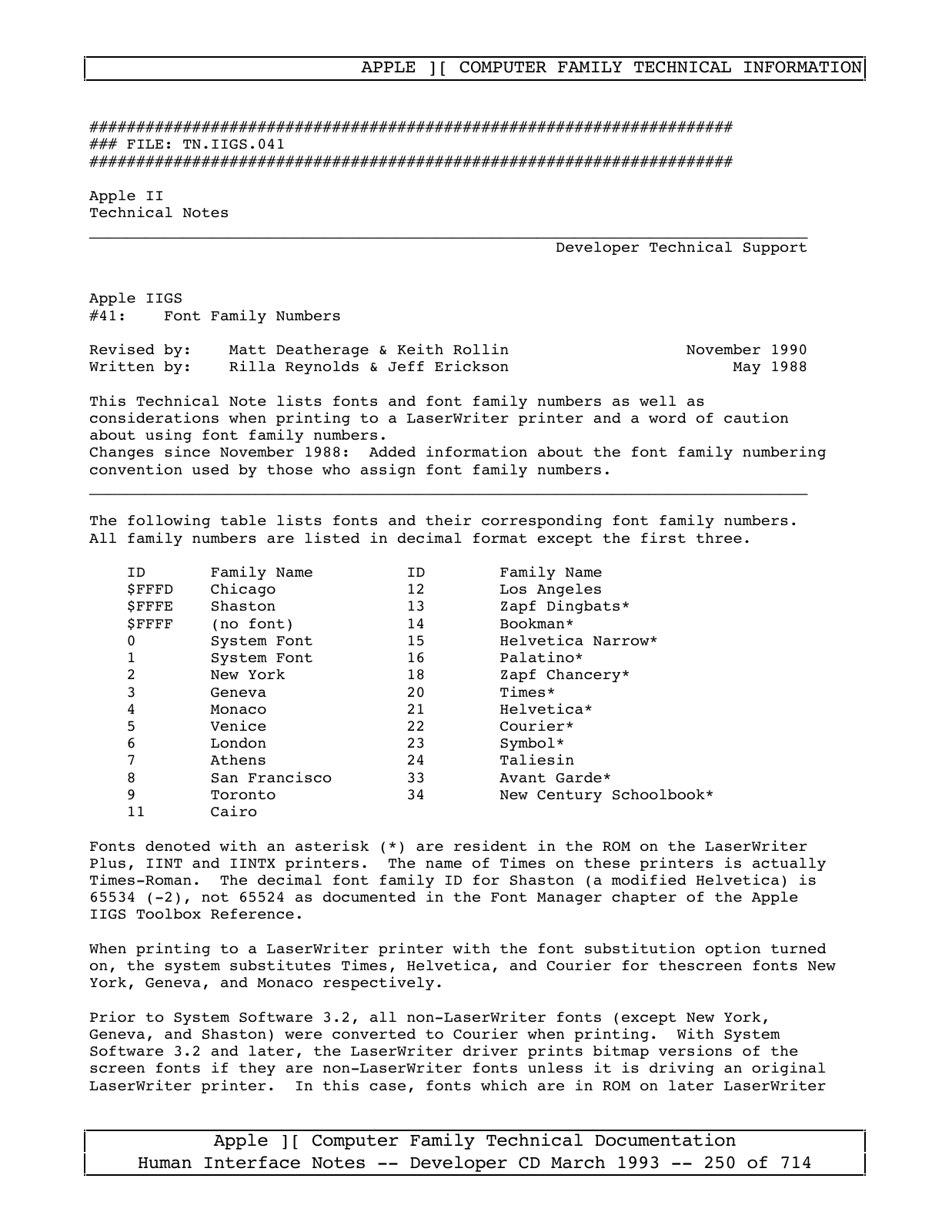
Full Font Family Numbers documentary page listing Shaston as $FFFE; the table’s printed letters are not a Shaston specimen
Documentary witness, not a glyph specimen · November 1990 note in March 1993 compilation

Shaston

Apple IIgs · Font Manager family ID

Apple IIgs Technical Note #41 names Shaston and assigns it family ID $FFFE, or 65534 (−2), in a November 1990 revision retained in the March 1993 compilation. The page describes Shaston as a modified Helvetica; this table is documentary evidence, not a Shaston lettering sample.

Format
Documentary excerpt
Page
Native PDF page 250 / compilation page “250 of 714”; Apple IIgs #41, Font Family Numbers, revised November 1990, in the Developer CD March 1993 compilation.
Sources & specimen
Timeline
1990 · The named font is documented by the retained November 1990 revision of Technical Note #41. The note also prints an original May 1988 authorship date, which does not establish that all retained table content appeared in the earlier version. Neither date establishes Shaston’s first release.
Specimen
1993
Credit
Apple Computer, Inc.; source PDF retained from the Apple documentation archival mirror

Rights retained by Apple Computer, Inc. and applicable publication rights holders. Contextual archival excerpt; no open reuse license asserted. No font software is distributed.
1991

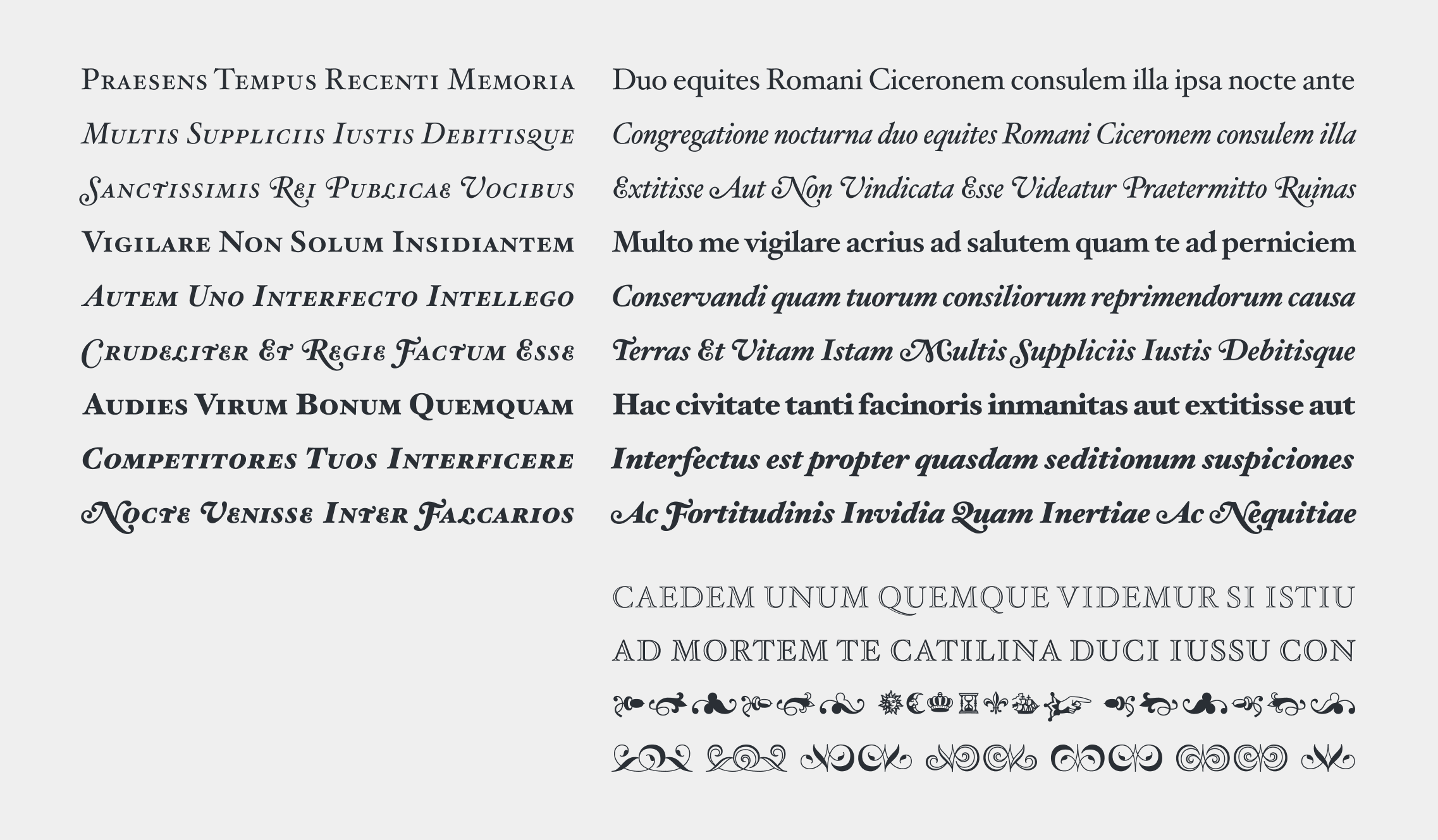
Jonathan Hoefler’s portfolio specimen of Hoefler Text, showing Latin roman and italic text, small capitals, engraved capitals and ornaments.
Undated specimen supplied in the designer’s Hoefler Text portfolio; 1991 dates the design, not this image.

Hoefler Text

Apple Computer commission · digital typography

Jonathan Hoefler’s portfolio identifies Hoefler Text as a 1991 design created for Apple Computer, with an extensive repertoire of traditional typographic forms.

Design
Jonathan Hoefler
Format
Designer portfolio specimen
Sources & specimen
Design
Jonathan Hoefler
Timeline
1991 · The source states designed in 1991; it does not establish an exact first shipping day or first operating-system version.
Specimen
1991
Credit
Jonathan Hoefler · portfolio specimen

Rights retained by the credited creators and publishers. Contextual archival reference; no open reuse license asserted. No font software is distributed.

1993

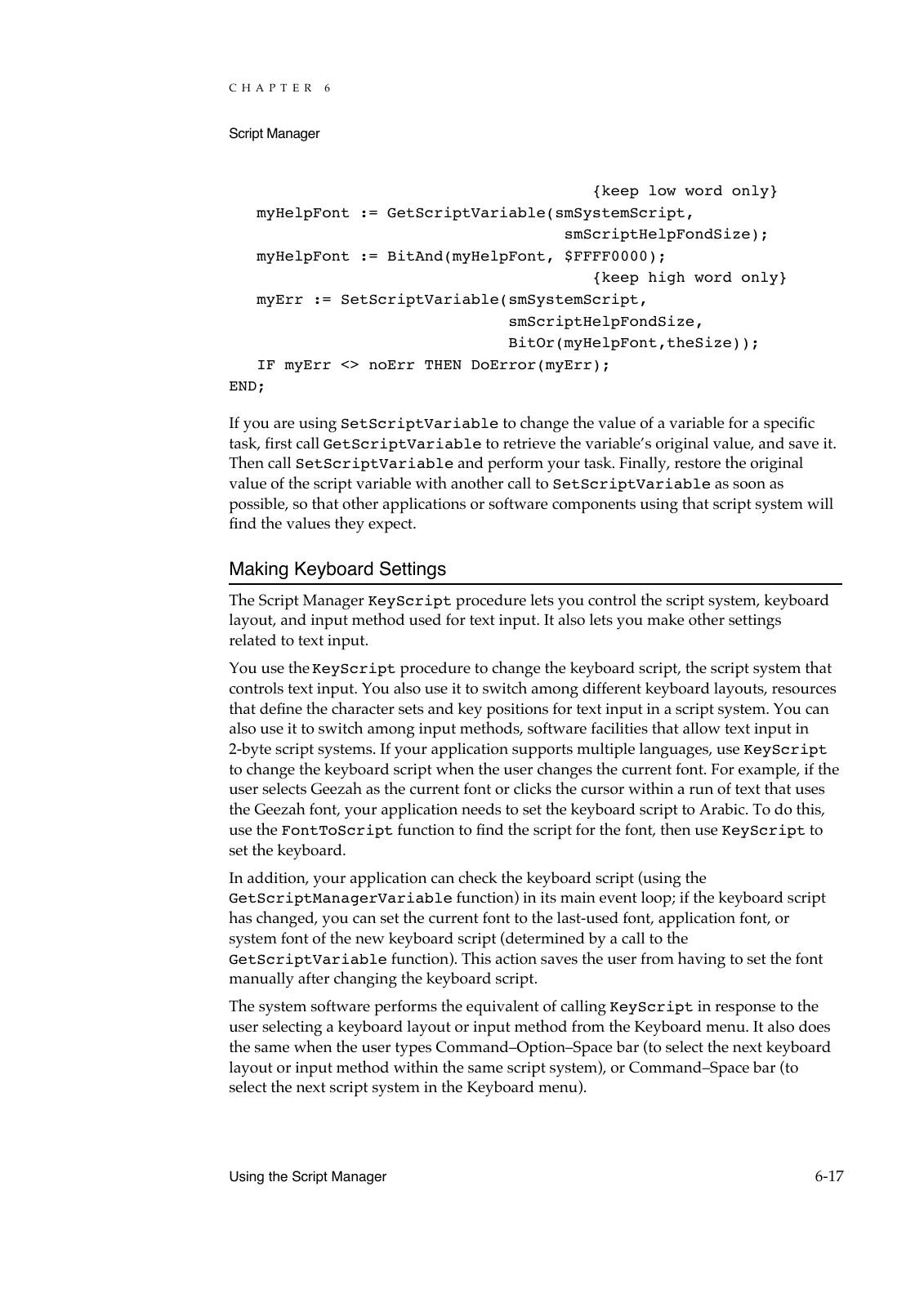
Complete Inside Macintosh: Text page 6-17 using Geezah as a named Arabic keyboard-script example; no Geezah glyph specimen is identified.
Named Arabic-font example, ©1993; no identified Geezah glyph sample

Geezah

Classic Macintosh · Arabic text and script selection

Apple’s ©1993 Script Manager documentation uses Geezah as an Arabic-font example when synchronizing the selected font and keyboard script. It does not identify a glyph specimen or declare this font the system default.

Format
Documentation excerpt
Page
Printed 6-17 / native PDF 643
Sources & specimen
Timeline
1993 · 1993 dates the named Geezah usage example. The source does not establish first release or individual designer, and does not establish equivalence with a later Geeza Pro family.
Specimen
1993
Credit
Apple Computer, Inc.

Rights retained by the credited creators and publishers. Contextual archival excerpt; no open reuse license asserted. No font software is distributed.
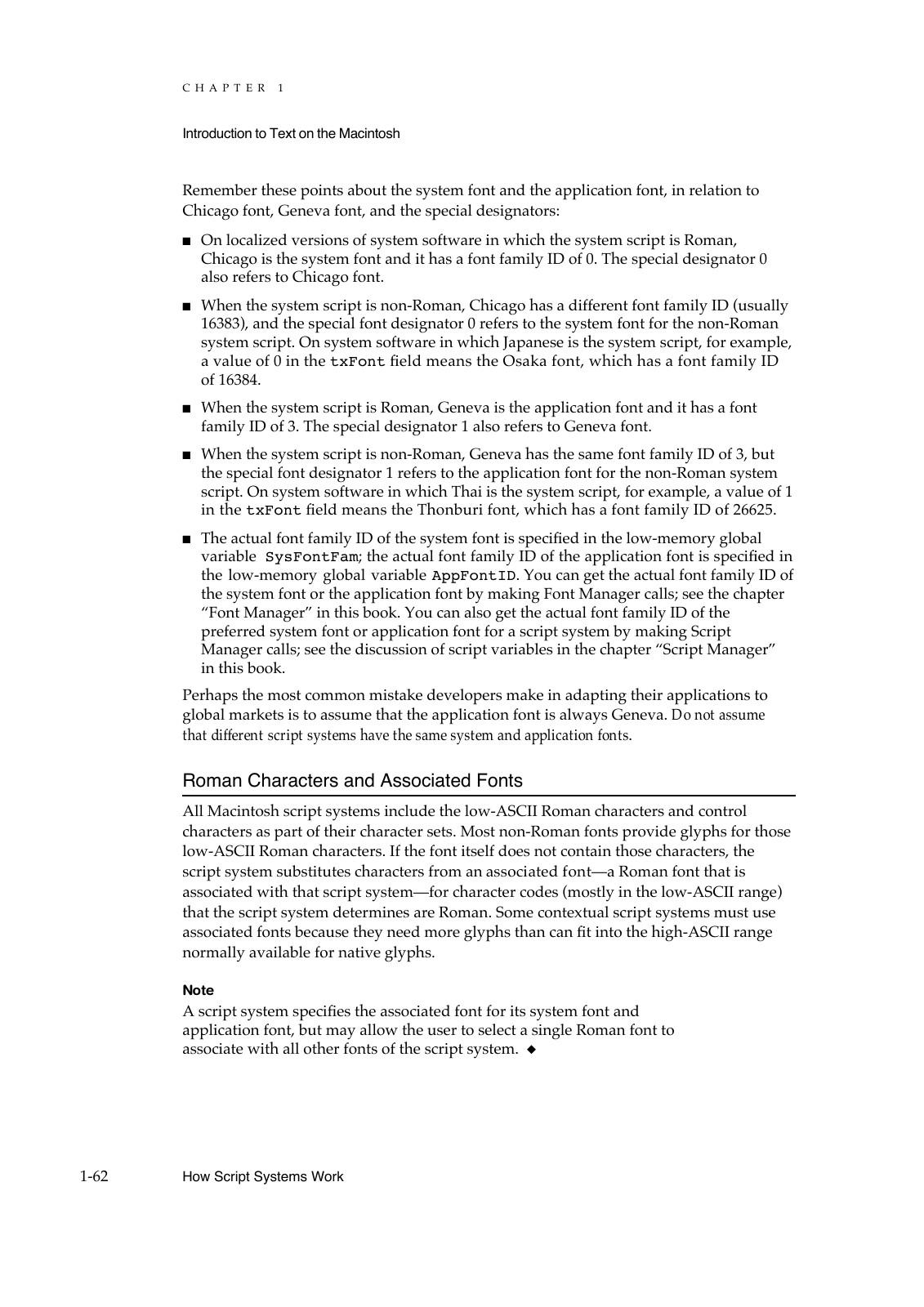
Complete Inside Macintosh: Text page 1-62 identifying Osaka as the Japanese system font and Thonburi as the Thai application font; the printed lettering is not identified as either font.
Named Japanese system-font reference, ©1993; documentation lettering is not an Osaka specimen

Osaka

Classic Macintosh · Japanese system font

Apple’s Inside Macintosh: Text identifies Osaka as the system font when Japanese is the system script. The retained page documents its role and family number rather than displaying an identified Osaka glyph sample.

Format
Documentation excerpt
Page
Printed 1-62 / native PDF 98; corroborating printed 6-67 / PDF 693
Sources & specimen
Timeline
1993 · 1993 dates this documented Japanese system-font role, not Osaka’s introduction. An original individual designer and exact first-use date are not established by the reviewed pages.
Specimen
1993
Credit
Apple Computer, Inc.

Rights retained by the credited creators and publishers. Contextual archival excerpt; no open reuse license asserted. No font software is distributed.
Complete Inside Macintosh: Text page 1-62 identifying Osaka as the Japanese system font and Thonburi as the Thai application font; the printed lettering is not identified as either font.
Named Thai application-font reference, ©1993; no identified Thonburi glyph sample

Thonburi

Classic Macintosh · Thai application font

Apple’s Inside Macintosh: Text names Thonburi as the application font selected when Thai is the system script, with family ID 26625. This is an application-font witness, not a claim that it was the Thai system font.

Format
Documentation excerpt
Page
Printed 1-62 / native PDF 98
Sources & specimen
Timeline
1993 · 1993 dates this Thai application-font documentation. The inspected source does not establish the family’s introduction, original individual creator, or the lineage of later implementations.
Specimen
1993
Credit
Apple Computer, Inc.

Rights retained by the credited creators and publishers. Contextual archival excerpt; no open reuse license asserted. No font software is distributed.
1994

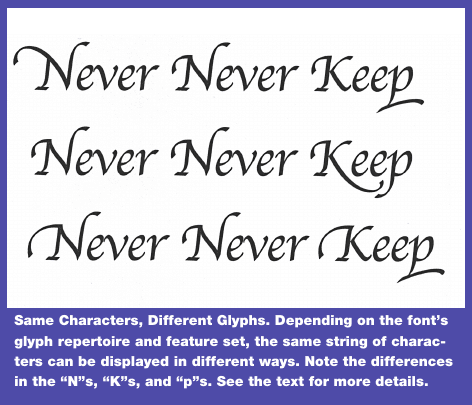
Three native Apple Chancery lines and their original caption, cropped from Apple Directions page 4; font identity is supplied by page 5
Apple Chancery contextual forms · Apple Directions, January 1994

Apple Chancery

QuickDraw GX · contextual letterforms

Three lines of the same text demonstrate alternate and contextual letterforms in Apple Chancery. The January 1994 Apple Directions names the font on the following page and explains its initial, final, and design-level options.

Design
Kris Holmes
Format
Document excerpt
Page
PDF page 4 / printed page 4, “Same Characters, Different Glyphs” panel; identity and explanation on PDF page 5 / printed page 5 under “Contextual Forms.”
Sources & specimen
Design
Kris Holmes
Timeline
1994 · The January 1994 issue explicitly identifies the pictured font as QuickDraw GX Apple Chancery. This is evidence of that contemporary demonstration; an exact first-use or introduction date remains unestablished.
Specimen
1994
Credit
Apple Computer, Inc.; source PDF retained from Steve Taylor’s Apple document archive

Rights retained by Apple Computer, Inc. and applicable publication rights holders. Contextual archival excerpt; no open reuse license asserted. No font software is distributed.
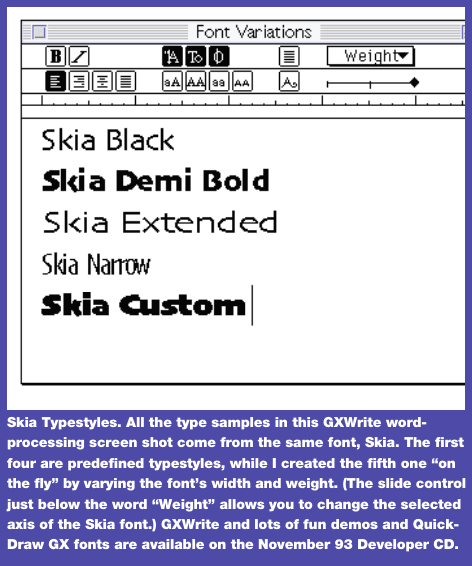
Skia’s five styles in the native GXWrite screenshot and original caption, cropped from Apple Directions page 5
Skia styles in GXWrite · Apple Directions, January 1994

Skia

QuickDraw GX · width and weight variations

A GXWrite screenshot in the January 1994 Apple Directions shows five Skia styles, including a custom width-and-weight variation. The article identifies Skia by name and explains its two variation axes.

Design
Matthew Carter
Format
Document excerpt
Page
PDF page 5 / printed page 5, “Skia Typestyles” screenshot and its caption; accompanying “Typestyles and Variation Axes” text.
Sources & specimen
Design
Matthew Carter
Timeline
1994 · Skia is named and demonstrated in the January 1994 issue. This documents the contemporary QuickDraw GX demonstration, not a verified first-release date. The caption mentions the November 1993 Developer CD generally; it is not an explicit dated manifest for this font.
Specimen
1994
Credit
Apple Computer, Inc.; source PDF retained from Steve Taylor’s Apple document archive

Rights retained by Apple Computer, Inc. and applicable publication rights holders. Contextual archival excerpt; no open reuse license asserted. No font software is distributed.
1995

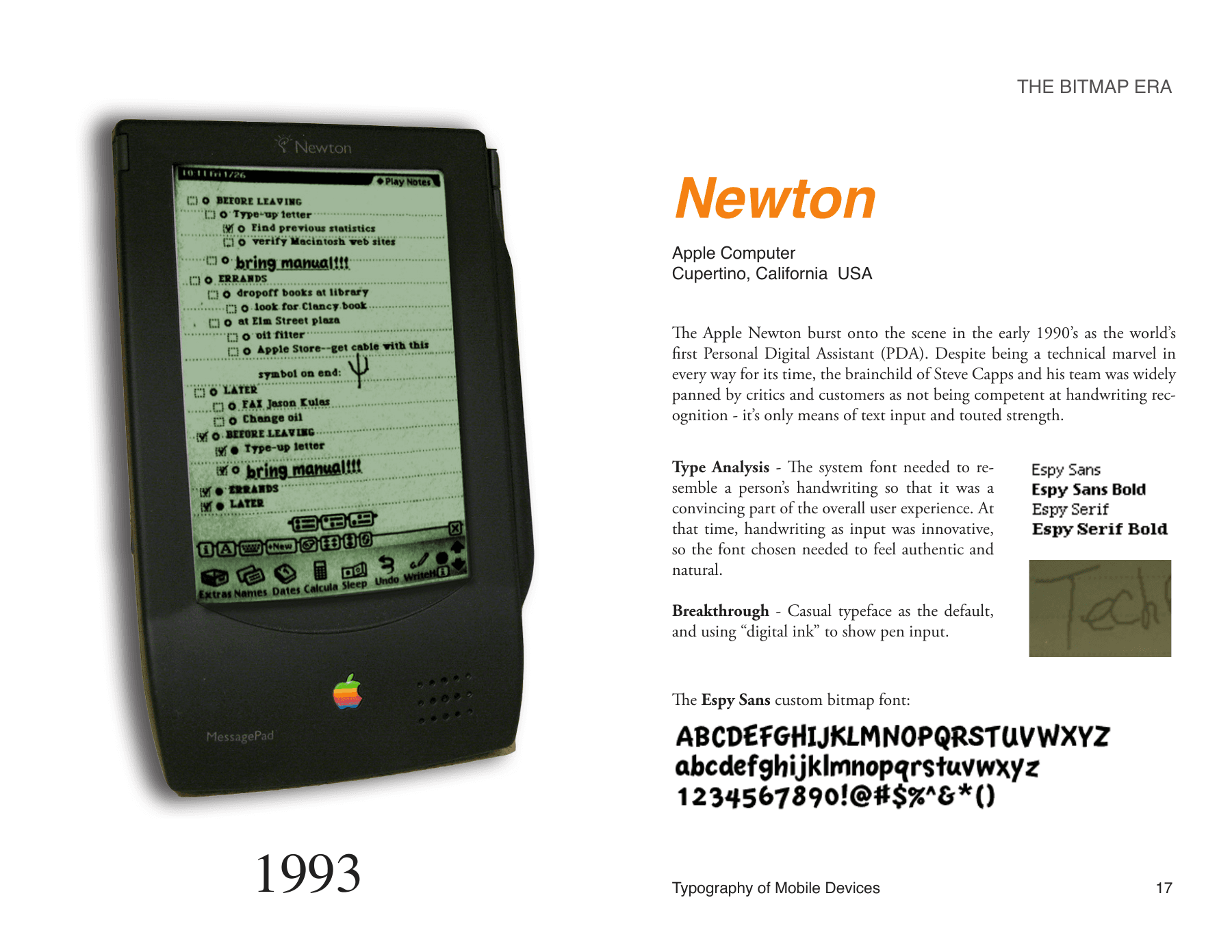
Espy Sans specimen in its complete source page, Printed page 17; PDF page 9
Typography of Mobile Devices, 2009

Espy Sans

Newton · bitmap text

Mike Pell’s 2009 Typography of Mobile Devices prints an Espy Sans bitmap alphabet beside a Newton MessagePad and the Espy family names. Apple’s preserved 1995 Newton Book Maker guide independently documents Espy Sans and Espy Sans Bold, with bitmap sizes 9, 10, 12, 14, and 18 points. The guide also explains that choosing the separate Bold font differs from applying a bold style to ordinary Espy Sans. The later specimen’s historical 1993 heading is distinct from its 2009 publication date.

Format
Document excerpt
Page
Specimen: Typography of Mobile Devices, PDF page 9 / printed page 17. Primary documentation: Newton Book Maker User’s Guide, PDF page 32 / printed 2-5; troubleshooting PDFpage 177 / printed B-2. Both complete provided PDFs retained.
Sources & specimen
Timeline
1995 · Apple’s 1995 guide directly documents the supported Espy bitmap fonts. The specimen book was published in 2009; neither source establishes an exact first-use date in 1993.
Specimen
2009
Credit
Mike Pell; original letterforms: Apple Computer, Inc.

Rights retained by the credited creators and publishers. Contextual archival excerpt; no open reuse license asserted. No font software is distributed.
1997

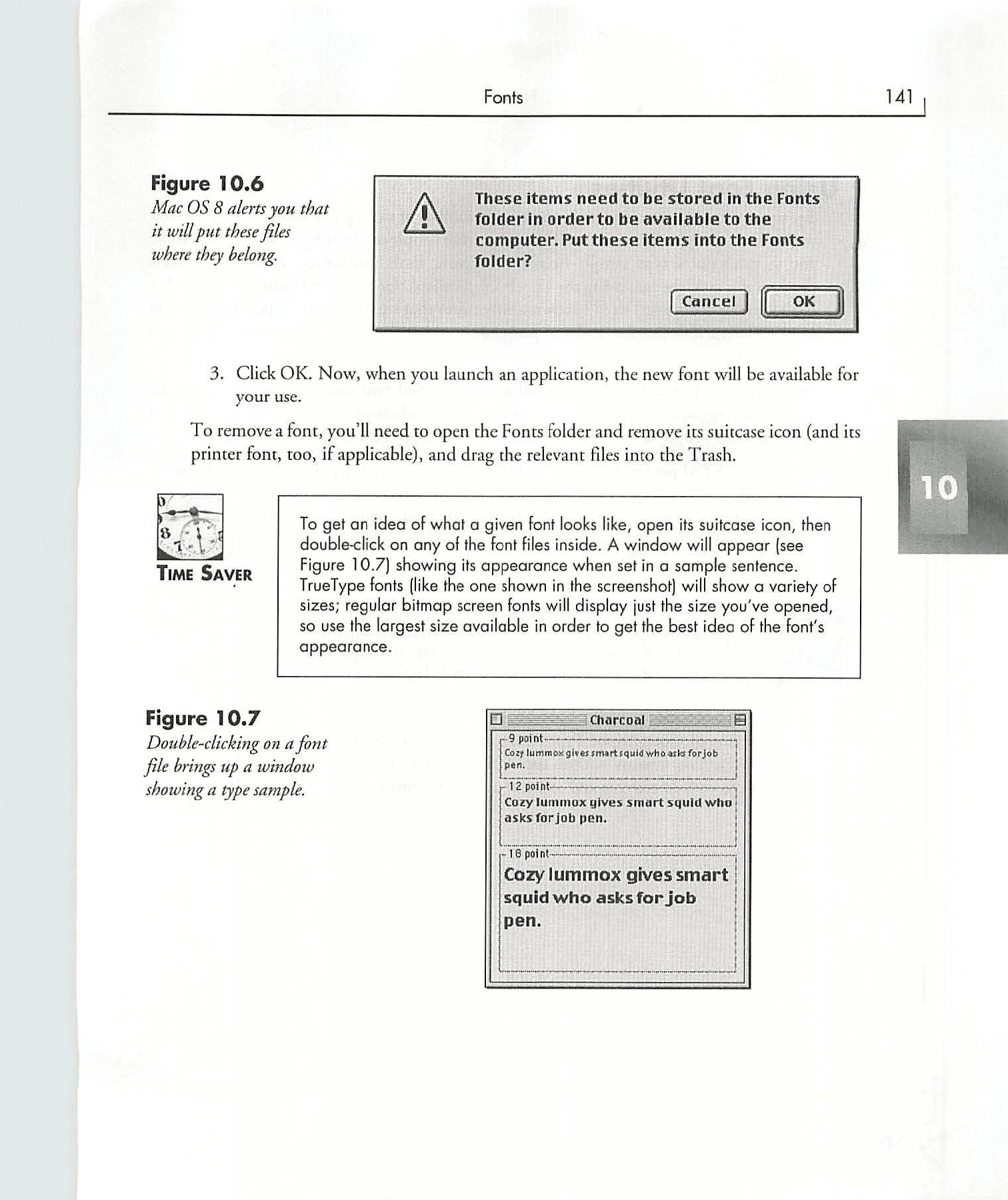
Charcoal specimen in its complete source page, Page 141, figure 10.7; PDF page 154
Mac OS 8 font window, 1997

Charcoal

Mac OS 8 · system interface

Figure 10.7 in the 1997 Teach Yourself Macintosh in 24 Hours shows a real Charcoal font window with 9-, 12-, and 18-point samples. The full page explains opening a font suitcase to inspect its available sizes in Mac OS 8, preserving the interface context around the cropped specimen.

Design
David Berlow / Font Bureau
Format
Document excerpt
Page
Printed page 141 / PDF 154, Figure 10.7. Complete provided 399-page PDF retained; unrelated content pages 17–18 are missing from that scan.
Sources & specimen
Design
David Berlow / Font Bureau
Timeline
1997
Specimen
1997
Date
The artifact year dates this source specimen, not a verified first release of the typeface.
Credit
Howard Baldwin and Anita Epler / Hayden Books; interface: Apple Computer, Inc.; scan: VintageApple.org

Rights retained by the credited creators and publishers. Contextual archival excerpt; no open reuse license asserted. No font software is distributed.
1998

Capitals

US Mac OS 8.5 · named new shipping font

Apple’s 1998 Mac OS 8.5 technote names Capitals as a new shipping font. Bigelow & Holmes’s own biographies credit Kris Holmes and Charles Bigelow with co-designing Apple Capitals.

Design
Kris Holmes and Charles Bigelow
Format
Named-font documentation reference
Sources & specimen
Design
Kris Holmes and Charles Bigelow
Timeline
1998 · 1998 dates Apple’s explicit US Mac OS 8.5 shipping documentation. An exact font introduction day and a default-interface role remain unestablished.
Specimen
1998
Credit
Apple Computer, Inc.; Bigelow & Holmes Inc.

Rights retained by Apple and the credited designers and publishers. Contextual archival documentation; no open reuse license asserted. No font software or newly created glyph specimen is distributed.

Gadget

US Mac OS 8.5 · named new shipping font

Apple names Gadget among the new fonts shipping with US Mac OS 8.5. A later Type Directors Club medal profile attributes Gadget to David Berlow’s core-font work for Apple.

Design
David Berlow (Type Directors Club attribution)
Format
Named-font documentation reference
Sources & specimen
Design
David Berlow (Type Directors Club attribution)
Timeline
1998 · 1998 dates Apple’s explicit US Mac OS 8.5 shipping documentation. An exact font introduction day and a default-interface role remain unestablished.
Specimen
1998
Credit
Apple Computer, Inc.; Paul Shaw / Type Directors Club

Rights retained by Apple and the credited designers and publishers. Contextual archival documentation; no open reuse license asserted. No font software or newly created glyph specimen is distributed.

Sand

US Mac OS 8.5 · named new shipping font

Apple’s Mac OS 8.5 technote names Sand among the new fonts shipping with the US version. This entry preserves that dated availability witness without assigning an unverified designer or first-release date.

Format
Named-font documentation reference
Sources & specimen
Timeline
1998 · 1998 dates Apple’s explicit US Mac OS 8.5 shipping documentation. An exact font introduction day and a default-interface role remain unestablished.
Specimen
1998
Credit
Apple Computer, Inc.

Rights retained by Apple and the credited designers and publishers. Contextual archival documentation; no open reuse license asserted. No font software or newly created glyph specimen is distributed.

Techno

US Mac OS 8.5 · named new shipping font

Apple’s Mac OS 8.5 technote names Techno among the new fonts shipping with the US version. This entry preserves that dated availability witness without assigning an unverified designer or first-release date.

Format
Named-font documentation reference
Sources & specimen
Timeline
1998 · 1998 dates Apple’s explicit US Mac OS 8.5 shipping documentation. An exact font introduction day and a default-interface role remain unestablished.
Specimen
1998
Credit
Apple Computer, Inc.

Rights retained by Apple and the credited designers and publishers. Contextual archival documentation; no open reuse license asserted. No font software or newly created glyph specimen is distributed.

Textile

Apple · appearance-font design and Copland theme development

Bigelow & Holmes’s firsthand history dates Textile’s Apple design to 1998 and traces its development to a playful Copland interface theme designed to contrast with Chicago.

Design
Bigelow & Holmes
Format
Designer documentation
Sources & specimen
Design
Bigelow & Holmes
Timeline
1998 · 1998 is the designers’ stated Apple design year. Work began during Copland development; first shipping date is not established here.
Specimen
1998
Credit
Bigelow & Holmes Inc.

Rights retained by Bigelow & Holmes and other credited rights holders. Contextual archival reference; no open reuse license asserted. No font software is distributed.

2001

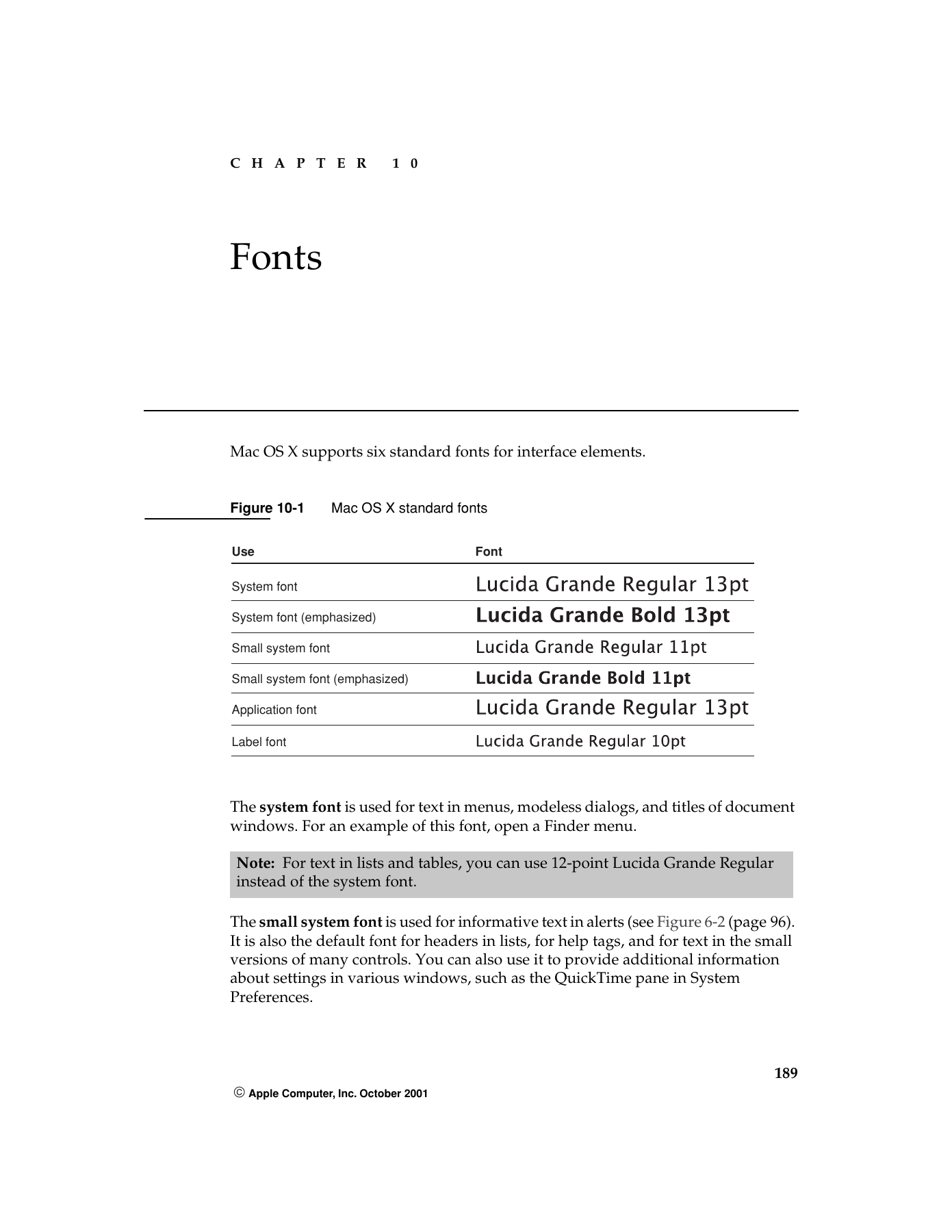
Lucida Grande specimen in its complete source page, October 2001, p 189, figure 10-1
Aqua Human Interface Guidelines, 2001

Lucida Grande

Mac OS X · Aqua interface

Apple’s October 2001 Aqua Human Interface Guidelines assign Lucida Grande to six interface roles. Figure 10-1 on page 189 shows regular and bold 13-point system fonts, regular and bold 11-point small system fonts, and the 10-point label font, with instructions for menus, dialogs, lists, and window titles.

Design
Charles Bigelow and Kris Holmes
Format
Document excerpt
Page
October 2001, p 189, figure 10-1
Sources & specimen
Design
Charles Bigelow and Kris Holmes
Timeline
2001 · 2001 marks the full-release Mac OS X interface documented by this October guide. Co-designer Charles Bigelow dates Apple’s Lucida Sans extension, renamed Lucida Grande, and its OS X beta distribution to 2000; 2001 is not the Lucida family’s original release.
Specimen
2001
Credit
Apple Computer, Inc.; preserved by Matt Sephton

Rights retained by the credited creators and publishers. Contextual archival excerpt; no open reuse license asserted. No font software is distributed.

2002

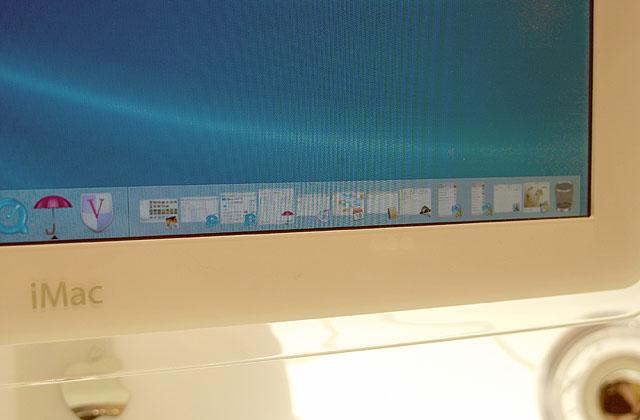
A contemporary PC Watch photograph records the iMac name in Apple’s new marketing lettering at Macworld New York in July 2002.
iMac wordmark, Macworld New York 2002

Myriad

Identity · product names

A contemporary PC Watch photograph records the iMac name in Apple’s new marketing lettering at Macworld New York in July 2002. The surrounding Japanese report explicitly discusses the change from Garamond to Myriad. The preserved photograph shows the wordmark on the display enclosure, rather than a newly typeset approximation.

Design
Carol Twombly and Robert Slimbach / Adobe
Format
Period photograph
Page
Photograph mwny3_07.jpg;18 July 2002
Sources & specimen
Design
Carol Twombly and Robert Slimbach / Adobe
Timeline
2002 · 2002 dates the contemporary Apple product-lettering example, not Myriad’s release. Adobe dates the original Myriad design to 1992; the July 2002 report does not establish Apple’s first use.
Specimen
2002
Credit
Impress / PC Watch; product lettering: Apple Computer, Inc.

Rights retained by the credited creators and publishers. Contextual archival excerpt; no open reuse license asserted. No font software is distributed.

Load more ↗